
PRIN PNRR 2022 — Digit4Circle
DIGItal Twins for CIRCuLar Economy | CUP: P2022788KK
DIGItal Twins for CIRCuLar Economy | CUP: P2022788KK
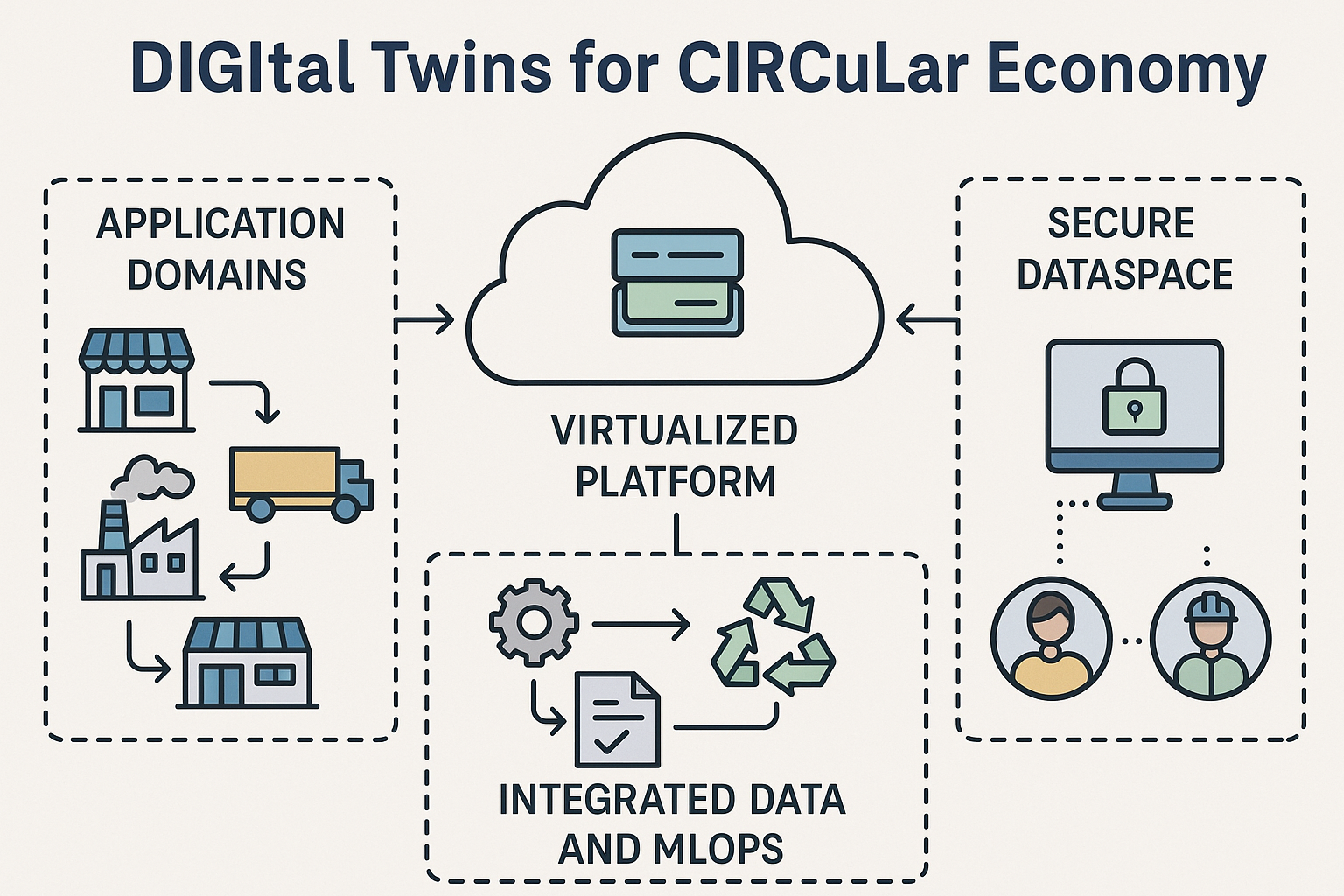
Digit4Circle set out to design and implement a middleware architecture aimed at federating domain-specific application islands, enabling an end-to-end Digital Twin (DT) model applicable to a broad spectrum of circular economy (CE) scenarios. The project successfully designed and validated a comprehensive framework combining methodological advancements and technological implementations for DT-enabled CE scenarios.
The architecture integrates multiple layers of information technologies and is supported by well-defined methodologies for modelling, data acquisition, analysis, and secure data exchange. Various iterations and verticalizations of the framework were explored and assessed to ensure adaptability across different use cases.
A virtualized platform for the dynamic federation of distributed resources, enabling on-demand convergence of domain-specific digital representations with localized intelligent feedback mechanisms.
Integrated data pipelines and MLOps-driven methodologies supporting data-driven decision-making for recycling and reuse, leveraging machine learning for classification, anomaly detection, and lifecycle analysis.
A secure and trusted data exchange framework across heterogeneous stakeholders, combining decentralized identity management, cryptographic verification, and privacy-preserving machine learning.
The DIGIT4CIRCLE framework is structured around three tightly integrated layers that together realize an end-to-end Digital Twin platform for circular economy processes:
The platform enables the representation and federation of distributed processes and resources, supporting on-demand federation of production units and demonstrating dynamic adaptation capabilities through localized intelligent feedback. Orchestration mechanisms — I-ORCAS [UNIBO-9] and CCOPE [UNIBO-14] — enable event-driven control loops and policy-based federation of virtualized and physical resources across cloud–edge environments. Semantic modelling activities [UNIBO-1] [UNIBO-2] [UNIBO-12] provide a formalized representation of system entities, relationships, and policies via Minimum Interoperability Mechanisms (MIMs), enabling consistent interpretation across components and facilitating interoperability. The CLUES community-driven sensing framework [UNIBO-3] extends the platform to participatory urban IoT scenarios.
Comprehensive data acquisition and management procedures cover collection, integration, and processing of heterogeneous data across the resource lifecycle [UNIPD-1] [UNIPD-2] [UNIPD-6]. MLCOps [UNIBO-6] provides a lightweight, decentralized MLOps management plane for the Cloud Continuum, enabling dynamic orchestration, monitoring, and adaptive reconfiguration of distributed ML services. An ANFIS-based data pipeline [UNIBO-5] enhances predictive maintenance and defect prediction under uncertain industrial conditions. A context-aware drift detection algorithm [UNIBO-7] distinguishes systematic from anomalous concept drift, reducing unnecessary retraining and ensuring ML model reliability in Digital Twin environments. Sensor selection via Shapley value analysis [UNIPD-3] demonstrates that up to 50% of sensors can be removed without loss of classification accuracy.
VESPACE [UNIBO-2], a blockchain-based dataspace platform, leverages Decentralized Identifiers (DIDs) and Verifiable Credentials (VCs) to ensure self-sovereign identity and data sovereignty, with IPFS-based off-chain storage preventing unnecessary data exposure. A multi-faceted interoperability model [UNIBO-1] provides standardized abstractions for data models, semantics, access rules, and governance across heterogeneous Digital Twin systems. Novel lightweight federated unlearning algorithms (FedUNRAN) [UNIBO-8] enable removal of local data contributions from global models without full retraining, preserving privacy-by-design principles. Age of Incorrect Information (AoII) modelling [UNIPD-5] [UNIPD-14] further reinforces data integrity and resilience against adversarial updates.
The most promising candidate solutions were evaluated within a real industrial testbed continuum environment, validating their performance, robustness, and operational viability under realistic deployment conditions. Extensions to state-of-the-art orchestration and virtualization frameworks such as Kubernetes ensured compatibility, scalability, and realistic deployment potential.
I-ORCAS [UNIBO-9] introduces an intent-based, serverless orchestration framework enabling event-driven control loops and fine-grained, location-aware execution across the Cloud Continuum, supporting dynamic reconfiguration of heterogeneous resources at runtime. CCOPE [UNIBO-14] formalizes a multi-layer orchestration model enabling policy-based federation of virtualized and physical resources, exposing a unified view of distributed infrastructures and supporting cross-domain coordination, SLA-aware control, and elastic service deployment. Resource slicing on commodity industrial platforms is further explored in [UNIBO-13].
MLCOps [UNIBO-6] provides a lightweight, decentralized MLOps management plane for the Cloud Continuum, enabling dynamic orchestration, monitoring, and adaptive reconfiguration of distributed ML services. An ANFIS-based data pipeline [UNIBO-5] combines fuzzy logic and machine learning for robust decision-making under uncertain and noisy industrial data. A context-aware distributed drift detection algorithm [UNIBO-7] distinguishes systematic from anomalous concept drift, reducing unnecessary retraining and ensuring ML model reliability in Digital Twin deployments. A hybrid simulation and AI-driven supply chain framework [UNIBO-12] integrates these pipelines with adaptive manufacturing decision-support.
The project introduces rigorous game-theoretic models for optimizing data collection from multiple independent and geographically distributed sources, with energy-aware federated client selection [UNIPD-1] and AoI-aware opportunistic sensing [UNIPD-2] showing significant node reduction without performance loss. The Age of Incorrect Information (AoII) [UNIPD-5] captures the joint impact of data staleness and incorrectness, while its bidirectional variant BAoII [UNIPD-14] enables modelling of mutual synchronization in Digital Twin environments. AoI-optimal scheduling strategies are developed for finite horizons [UNIPD-9] [UNIPD-12] [UNIPD-16], including real 5G deployments [UNIPD-13].
VESPACE [UNIBO-2] is a verifiable blockchain-based dataspace solution combining self-sovereign identity (DIDs/VCs), cryptographic verification, and IPFS-based off-chain storage. A complementary multi-faceted interoperability model [UNIBO-1] provides standardized abstractions (MIMs) for data models, semantics, access rules, and governance across heterogeneous Digital Twin systems. Game-theoretic analysis of federated data ecosystems is provided in [UNIBO-10] / [UNIPD-15].
FedUNRAN [UNIBO-8] introduces novel lightweight on-device federated unlearning algorithms that enable the removal of local data contributions from global federated learning models without requiring full retraining. This preserves privacy-by-design principles and strengthens user control over data, making FL deployments more compliant with data regulations and adaptable to evolving data governance requirements. Industry 5.0 DevOps aspects integrating secure OT orchestration are further addressed in [UNIBO-11].
CLUES [UNIBO-3] introduces a participatory and decentralized sensing paradigm for smart cities, based on community-driven LoRa networks and smart home gateways, enabling low-cost, scalable, and locally enriched data collection and sharing. Coordination mechanisms from I-ORCAS [UNIBO-9] and CCOPE [UNIBO-14] enable dynamic resource coordination and adaptive deployment of sensing and analytics services over distributed cloud–edge infrastructures. Application-level extensions to logistics and metaverse scenarios are explored in [UNIPD-11] and [UNIPD-6].
Both operational units collaborated closely across Work Packages (WPs), pursuing an iterative and agile approach to design, validation, and experimentation. Below is a summary of each unit's core contributions.
The UNIBO unit was the lead unit for the project, concentrating on WP1 and WP4. Its core technical objective was to design and implement a distributed Digital Twin middleware platform enabling the seamless integration of heterogeneous data sources, computational components, and stakeholders into a unified, scalable architecture supporting Circular Economy scenarios.
Key contributions include: the VESPACE blockchain-based dataspace with DIDs/VCs for verifiable cross-domain data sharing; a multi-faceted interoperability model using Minimum Interoperability Mechanisms (MIMs) and a serverless event-driven architecture; a distributed DT-based decision-support framework for manufacturing supply chains integrating hybrid simulation and AI-driven adaptive optimization; I-ORCAS and CCOPE orchestration frameworks for dynamic resource management; MLCOps for decentralized ML operations; and FedUNRAN for on-device federated unlearning. All solutions were validated in real industrial testbed and cloud–edge continuum environments.
The UNIPD unit concentrated on WP2 and WP3, addressing the foundations of distributed data acquisition, participation optimization, and information freshness. A central research direction was how to efficiently orchestrate large-scale, distributed sensing and learning in resource-constrained, autonomously behaving agent scenarios.
Key contributions include: game-theoretic federated client selection strategies with age-based incentives (UNIPD-1); AoI-aware opportunistic sensing demonstrating significant node reduction without performance loss (UNIPD-2); Shapley value analysis for sensor selection in ML pipelines, enabling up to 50% sensor removal without accuracy loss (UNIPD-3); AoII and BAoII metrics for capturing data freshness, correctness, and bidirectional synchronization in Digital Twin environments (UNIPD-5, UNIPD-14); DCP, a TCP-inspired online domain adaptation method for dynamic data drift (UNIPD-7); and coordination mechanisms for smart microgrids and metaverse logistics via Markov games (UNIPD-8, UNIPD-11).
The project involves two Italian universities collaborating across all work packages, from November 2023 to February 2026.